
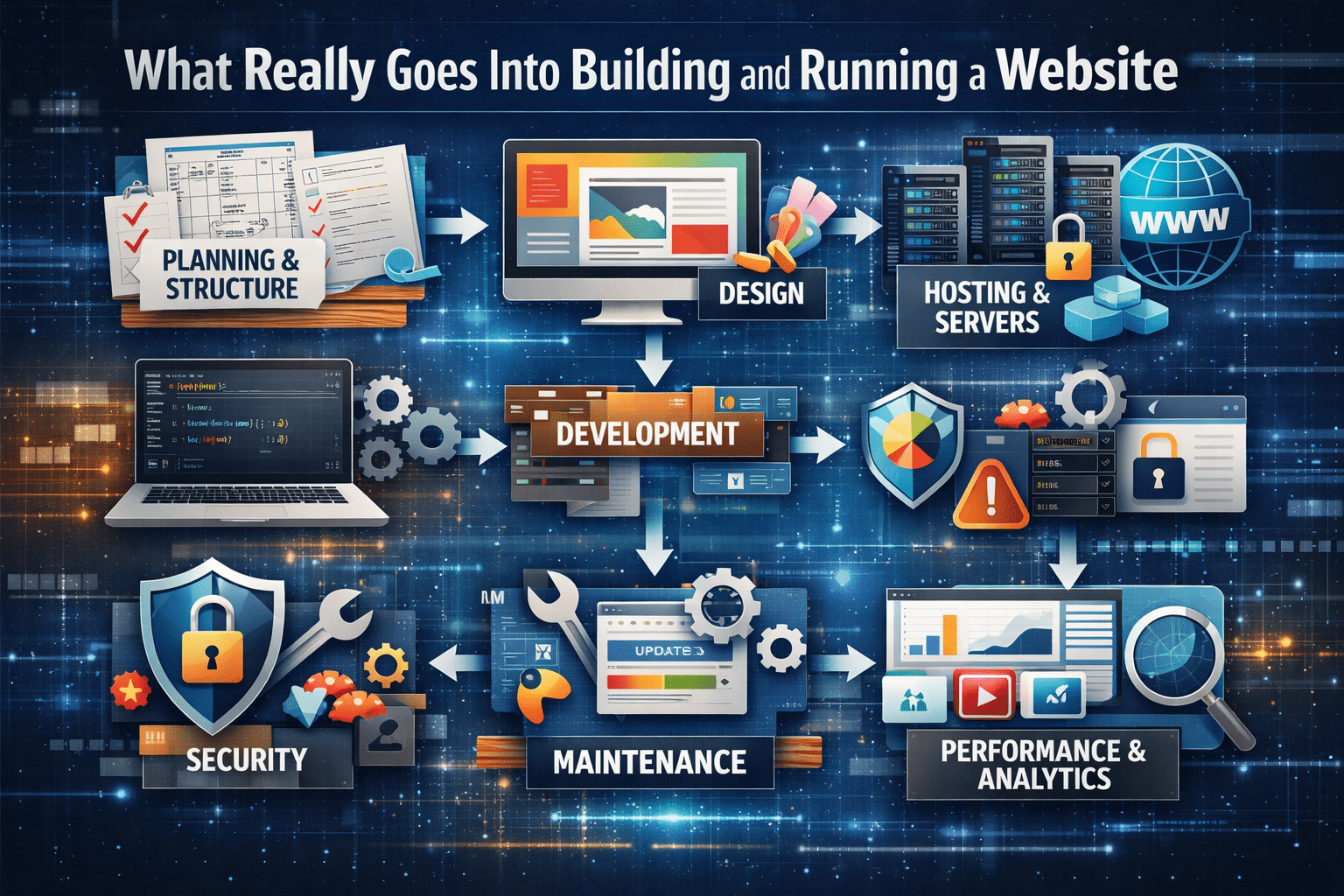
Most people see a website and assume it’s just a few pages on the internet. In reality, a working website is a combination of design, engineering, infrastructure, security, and ongoing maintenance.
A website starts with planning and structure. Before anything is built, someone has to decide what the website needs to do, how users will navigate it, what pages are required, and how information will be organized. This stage often involves wireframes, user experience planning, and content strategy.
Next comes design. Designers create the visual layout—colors, typography, spacing, graphics, and branding—while also ensuring the site works well on phones, tablets, and desktops. Modern websites must be responsive, meaning they automatically adapt to different screen sizes and devices.
After design comes development, which is where the site is actually built. Developers write code that turns the design into a functioning system. The front-end (what users see) is built using technologies like HTML, CSS, and JavaScript. The back-end (what runs behind the scenes) handles databases, user accounts, forms, payments, and any dynamic functionality. This often involves server-side languages, APIs, and database systems.
Then there is hosting and infrastructure. A website must live on a server so it can be accessed from anywhere in the world. This includes configuring hosting environments, domain names, SSL certificates for security, backups, and performance optimization so pages load quickly.
But launching a website is only the beginning.
A website requires continuous maintenance. Software needs updates, plugins and frameworks change, security vulnerabilities appear, and servers must be monitored. Without maintenance, websites can become slow, insecure, or completely break.
There is also content management. Pages need updating, new products or blog posts get added, images are optimized, and outdated information must be removed. Search engine optimization (SEO) also requires ongoing adjustments so the site remains visible in search results.
On top of that, there’s security management. Websites are constantly scanned by bots looking for weaknesses. Developers must manage firewalls, updates, malware protection, and backups to ensure the site remains safe and recoverable.
Finally, there is performance and analytics. Website owners track visitor behavior, optimize loading speeds, improve user experience, and adjust the site based on real data.
When you combine all of these pieces—planning, design, development, hosting, security, maintenance, and optimization—you realize that a website is not a one-time task. It’s an ongoing digital system that requires continuous work to keep running smoothly.
That’s why building and maintaining a quality website takes time, expertise, and consistent effort behind the scenes.